A uniform is more than something employees wear. It’s a visible part of your brand and a daily tool for the people representing it. A practical case for convincing your boss to invest in quality uniforms starts with showing how thoughtful choices can support both your team and your business.
It’s reasonable to question a higher upfront investment when lower-cost options seem to do the same job. But uniforms suited to the work can create a consistent brand presence, support staff comfort, and help make a polished first impression on customers.
This guide will help you build a clear, business-focused argument. You’ll learn how to connect uniform quality to brand visibility, staff comfort, weather resistance, and customer experience, then turn those benefits into a practical proposal your boss can evaluate. The strongest case isn’t about choosing the most expensive option. It’s about matching the uniform to the people, work, and impression your organization wants to make.
Key Takeaways
- Frame uniforms as a brand touchpoint that can help your team stand out and stay recognizable.
- Connect comfort and weather-ready choices to the conditions employees face during their workday.
- Show how a consistent, professional appearance can make staff easier for customers to identify.
- Build a practical proposal around employee needs, brand goals, and the value of choosing uniforms suited to daily use.
Brand visibility and differentiation
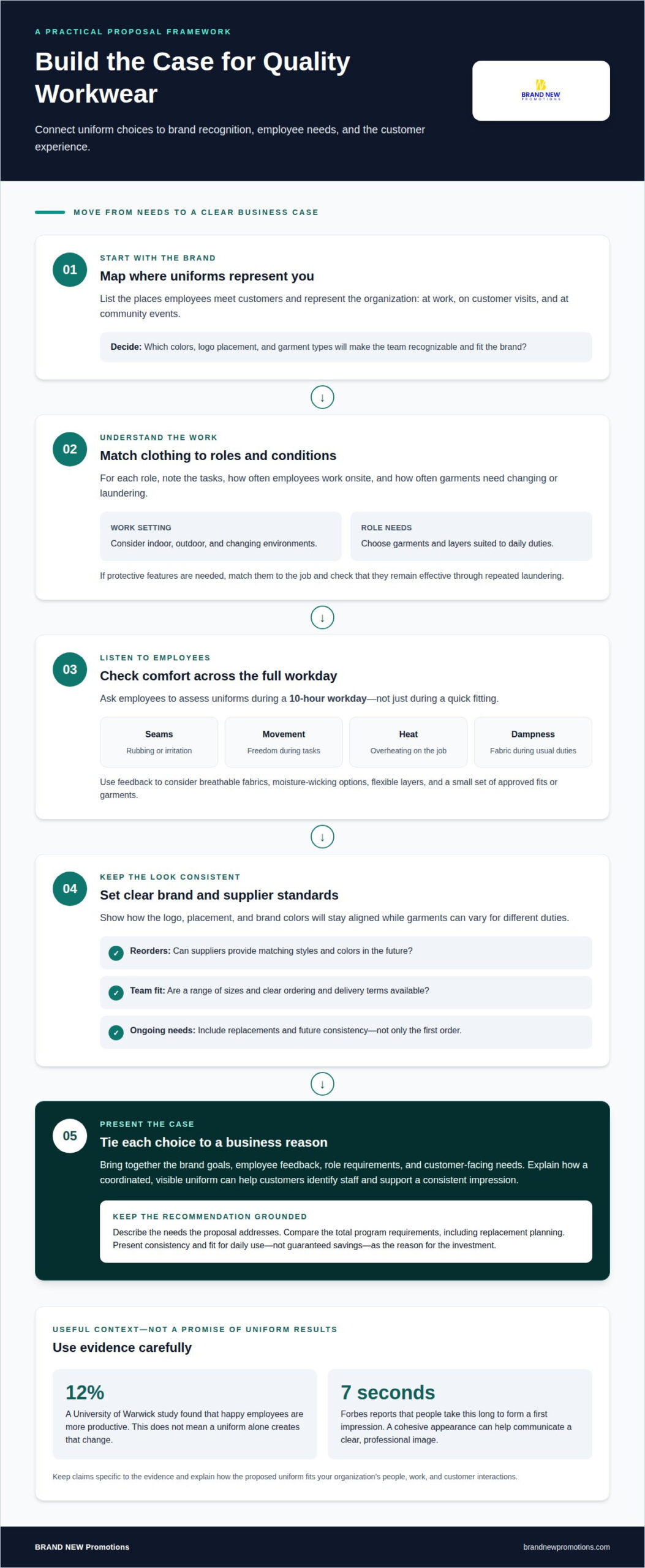
- Map each uniform to a brand touchpoint. Employees in coordinated workwear can represent your brand at the workplace, during customer visits, and at community events. For example, a Dallas service team wearing coordinated shirts is easier to recognize than staff in unrelated outfits. Connect colors, logo placement, and garment type to the brand identity you want customers to remember.
- Compare suppliers and contract terms before recommending a program. Look at whether they can provide matching styles and colors for future reorders, a range of sizes, and clear ordering and delivery terms. These details affect whether new hires can match the existing team and whether the uniform offering remains consistent. Compare the total program needs, including replacement planning, rather than focusing only on the first order.
- Estimate uniform needs by role and work pattern. List employee positions, their tasks, how often they work onsite, and how frequently garments need changing or laundering. Then identify the apparel each role needs, such as everyday branded clothing or layers suited to the work setting. Role-specific uniforms can help identify who belongs in particular work areas and support applicable safety standards. Make sure any protective features suit the job and remain effective through repeated laundering.
- Choose a clear branding method and show how it supports recognition. Embroidery can place a company name or logo on apparel, giving employees a consistent way to represent the business. Keep the design easy to identify and aligned with existing brand colors. For example, a small team can use the same logo placement across roles while selecting different garments for indoor and outdoor duties. Businesses planning team identity can explore branded sports uniforms as one example of coordinated apparel. Present the proposal as a commitment to brand consistency, workplace identity, and fewer mismatched purchases over time, not as a promise of guaranteed savings.
Comfort, breathability, and weather resistance
Build the proposal around employees’ working conditions, not appearance alone. Uniforms should feel comfortable throughout the shift and suit indoor, outdoor, and changing environments.
Assess Comfort Throughout the Workday
Review how a uniform feels during a 10-hour workday, from the first task to the final handoff. Ask employees to note rubbing seams, restricted movement, heat, and damp fabric during their usual duties. A warehouse employee lifting boxes needs different freedom of movement than a receptionist at a front desk. Avoid judging comfort from a quick fitting alone.
Connect Comfort With Performance
Show how comfortable workwear can support employee confidence and focus. A University of Warwick study found that happy employees are 12% more productive. This does not mean a uniform alone creates that change. It does give managers a reason to consider clothing as part of the workplace experience, alongside practical needs and employee feedback.
- Match fabric and layers to the work setting. Staff moving between a cool indoor space and outdoor duties may need flexible layers. Breathable fabrics and moisture-wicking technology can help maintain a stable body temperature. For a Dallas team working outside, gather feedback about heat, sun exposure, and movement before selecting a functional design.
- Include employee choice within clear brand guidelines. Offer a small set of approved fits or garment options, then ask employees which feel comfortable for their roles. This gives staff a voice while maintaining a coordinated appearance. A better fit can make wearing a uniform feel like a practical team choice rather than an expense imposed without input.
- Present comfort as part of the business case. Record common concerns, such as overheating during outdoor tasks or limited mobility when lifting, and connect each concern to a design decision. A concise brief can help managers weigh employee needs alongside branding goals. Start a uniform project with the work setting, team feedback, and brand priorities in view.
Professional image and customer first impressions
- Define the impression customers should take away. Choose a consistent look that fits the service, setting, and brand. A Dallas hotel team may need a polished appearance at the front desk, while a repair crew needs clothing suited to active work. Forbes reports that people take seven seconds to form a first impression. Use that brief window to present a clear, cohesive image.
- Make employees easy to recognize. A visible logo and coordinated clothing help customers identify staff and know whom to approach. For example, a customer entering a busy store can spot an employee in a branded shirt more easily than someone wearing everyday clothing. This practical detail can make the first interaction smoother and help staff appear approachable without relying on customers to guess who can assist.
- Connect appearance with trust, while keeping claims specific. A study published in the Journal of Healthcare Management found that medical professionals’ appearance significantly affects patient trust and satisfaction. In healthcare settings, this supports discussing professional presentation as part of the patient experience. In other workplaces, explain how consistent uniforms help customers recognize the team and create a dependable impression.
- Plan for a professional look that lasts. Choose clothing suited to regular wear, and set a clear standard for fit, logo placement, and condition. Faded or mismatched uniforms can weaken the cohesive image employees are meant to present. Ask customer-facing staff what questions or reactions they hear, then use those examples to show how appearance affects service interactions.
Making the case for investing in quality uniforms
A practical way to convince your boss to invest in quality uniforms is to connect garment lifespan with team needs and replacement planning. A clear comparison helps managers weigh quality against repeated replacement.
-
Assess Uniform Lifespan
Track how garments hold up under the team’s actual work and care routine. There’s no single lifespan for every uniform: fabric, daily wear, laundering, and job demands all affect when replacement makes sense. The U.S. Environmental Protection Agency notes that reusable industrial uniforms are typically more durable than disposable alternatives, despite heavy use. Avoid promising a fixed wear period without evidence from your own program.
-
Estimate the Return on Investment
Estimate ROI by comparing the full program expense with replacement frequency and practical business value. There’s no universal return figure: results depend on garment lifespan, care needs, staff use, and the value of consistent branding. Track orders, replacements, employee feedback, and customer responses before and after a change. That record gives management a grounded basis for judging whether quality uniforms support business goals.
-
Gather Persuasive Evidence and Examples
If convincing your boss to invest in quality uniforms is your goal, bring specific examples to the meeting, not broad claims. Show a worn garment beside a proposed alternative, then document issues such as fading, seam failure, or poor fit. Gallup reports that 36% of employees say they are highly involved in, enthusiastic about, and committed to their work and workplace. Connect uniform comfort and team identity to morale, but don’t claim apparel alone will change engagement.
Then present a focused proposal: which roles need an update, what outcomes matter, and how the team will evaluate the change. A corporate service team, for example, could track replacement requests and customer comments. For a practical starting point, shape your uniform project around your team’s needs and brand goals.
BRAND NEW Promotions | Top Promo Supplier in North Texas
BRAND NEW Promotions helps North Texas businesses turn uniform goals into a cohesive brand experience. Its promotional marketing services connect custom apparel with the impression your team wants to make. With graphic design and branding support, uniforms can reflect your workplace identity, customer experience, and team needs. “Built on Relationships. Backed by Results.”
For example, Embroidery can add a consistent logo to Embroidered Polo Shirts, helping customer-facing employees present a coordinated look. The right approach starts with your priorities, such as comfort, role-specific needs, and recognizable branding, rather than choosing garments in isolation.
If you’re ready to discuss your uniform goals, contact BRAND NEW Promotions | Top Promo Supplier in North Texas.
Turn Your Uniform Proposal Into a Practical Next Step
If you’re responsible for convincing your boss to invest in quality uniforms, keep the conversation moving with a proposal grounded in your team’s needs. Set a clear goal, such as a more consistent customer experience or apparel employees can wear comfortably throughout their shifts. Then agree on how you’ll assess the program over time. That makes it easier to revisit the decision as roles, brand needs, and employee feedback change.
BRAND NEW Promotions supports North Texas organizations with promotional marketing, promotional products, and custom apparel, including embroidery. The right combination depends on what your team needs to communicate and where employees represent the organization. From Plano, Frisco, Dallas, Wylie, Sherman, The Colony, Melissa, and Richardson, businesses can plan branded apparel that makes workwear a consistent part of the customer and employee experience. “Built on Relationships. Backed by Results.”
Start a uniform conversation with BRAND NEW Promotions | Top Promo Supplier in North Texas, and take the next step toward workwear that fits your team and your brand.
Frequently Asked Questions
Why Is It a Good Idea to Invest in Corporate Uniforms?
Corporate uniforms can give an organization a clear, repeatable dress standard across departments and shifts. That helps managers set expectations for new hires and plan workplace attire around each role. For example, a company with office and field staff can define a shared visual standard while allowing role-appropriate garments. This makes uniform planning part of workforce organization, not simply a clothing decision.
What Are the Benefits of Quality Uniforms for Employee Morale and Productivity?
Uniforms can reduce the need for employees to decide which personal clothes meet workplace expectations. That can make getting ready for a shift simpler and reduce uncertainty about dress rules. A clear policy also gives supervisors one shared standard to explain during onboarding. To make it workable, communicate what employees receive, how the clothing is used, and how questions or concerns are handled.
How Do Quality Uniforms Improve Customer Perceptions and Brand Image?
Uniform choices can align employees’ appearance with the service customers expect. A formal consulting office may choose a different look from a casual recreation program, even if both use branded apparel. Match the uniform’s style and decoration to the organization’s customer promise. This helps avoid a disconnect between how a business presents itself and the experience customers encounter.
What Is the Cost Difference Between Quality and Budget Uniforms?
There’s no single cost difference that applies to every uniform order. The comparison depends on garment construction, decoration method, order quantity, and design placement or complexity. For a fair review, compare options with the same intended use and decoration plan. Separate garment and branding choices in the proposal so managers can see what drives the difference.
What Is the Total Cost of Ownership of Uniforms, Including Laundering, Repairs, and Replacement?
Calculate total ownership by adding garment purchasing, laundering, repairs, replacements, and the staff time spent managing the program. Use the same review period for each option, and include internal tasks such as sorting orders or distributing garments. Clarify who launders uniforms and how damaged items are reported. That gives managers a fuller view than the order total alone.
What Are Common Employee Complaints About Uniforms, Fit, Comfort, and Fabric?
Employees may raise concerns about sizing consistency, available fits, or whether different garments suit their roles. Create a private way to collect feedback, then group responses by job type and garment. This can reveal whether one adjustment would help a whole team or whether needs differ by role. Use the findings to refine the uniform plan before making it a standard expectation.