Your company logo isn’t just a graphic; it’s a piece of tactile engineering where thread density and fabric choice determine your brand’s authority. If you’ve ever dealt with a logo that looks puckered or thread that fades after three washes, you know that quality custom embroidery is about much more than just a needle and thread. It’s frustrating to invest in bulk orders only to receive apparel that feels messy rather than executive.
We believe your team deserves a polished look that stays sharp through industrial washing and heavy use. This guide will help you master the technical nuances of professional branding so you can build a reliable identity. We’ll walk through the latest 2026 industry standards, including critical updates like California’s SB 707 textile regulations and the newest FTC “Made-in-USA” labeling rules, ensuring your next project is both compliant and premium.
Key Takeaways
- Learn how multi-head commercial machines deliver consistent, high-end branding across your entire team’s apparel.
- Understand the digitizing process to ensure your custom embroidery remains crisp and professional without puckering or messy threadwork.
- Identify the best fabric weights and apparel styles to prevent thread pull and ensure your branded gear survives industrial washing.
- Apply the 0.25-inch text height rule and color palette strategies to optimize your designs for bulk production efficiency.
- Leverage local North Texas expertise to manage your promotional marketing from creative design to final delivery.
What is Custom Embroidery? The Science of Professional Threading
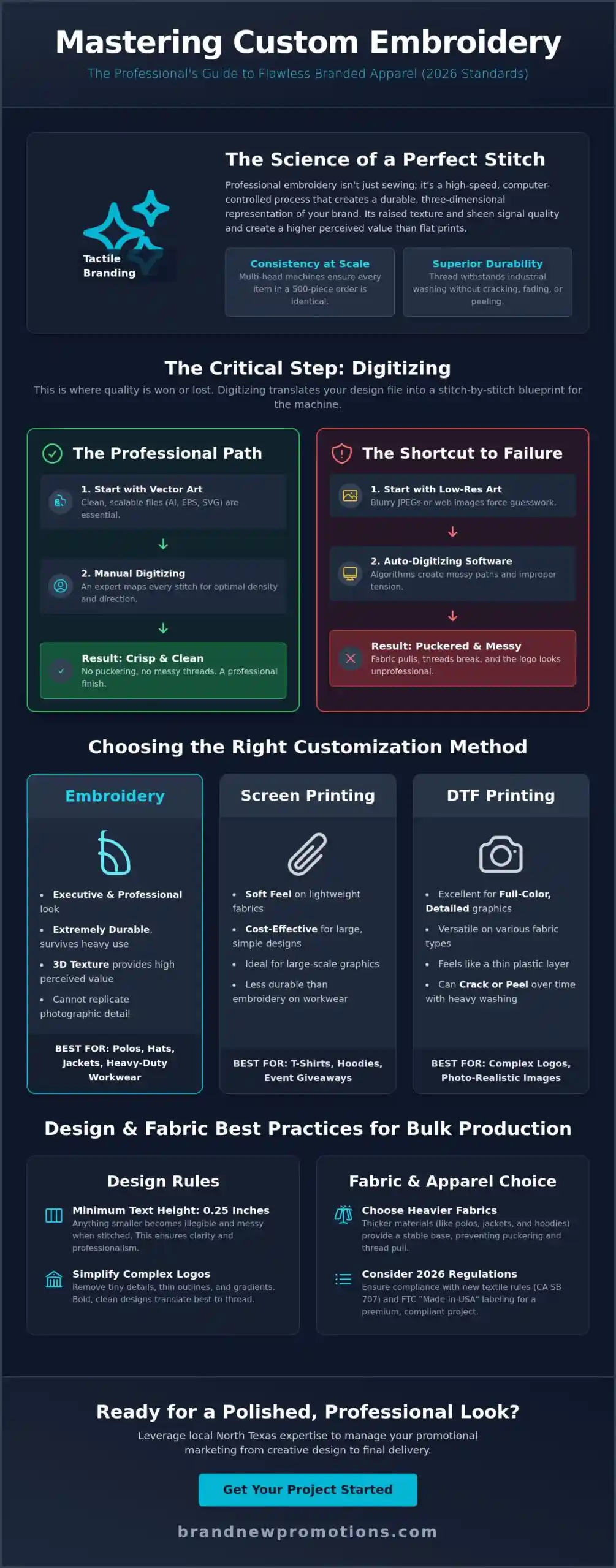
Custom embroidery is a high-speed, precision-driven customization method that uses specialized needles and durable threads to recreate your logo directly on fabric. It isn’t just about decoration; it’s a sophisticated production technique built for scale and permanence. While hobbyist sewing machines might handle a single shirt, professional branding relies on industrial multi-head commercial embroidery machines. These powerhouse units allow us to run dozens of items simultaneously, ensuring every stitch on the first polo matches the last one in a bulk order of five hundred.
The modern computer-controlled embroidery process has transformed a traditional craft into a digital science. This technology ensures your brand identity remains consistent across different batches and apparel types. When you choose embroidery, you’re investing in a medium that offers a significantly higher perceived value than standard ink-based printing. The raised texture and slight sheen of the thread signal quality and attention to detail to every client or partner who sees your team.
The Anatomy of a Stitch: Why Texture Matters
Texture is the secret weapon of custom embroidery. Unlike flat prints, embroidered designs are three-dimensional. They catch the light and create shadows, giving your logo a physical presence that people can feel. This tactile branding builds immediate trust. It suggests that your company values craftsmanship and isn’t looking for the cheapest, fastest shortcut. In 2026, we use digital precision to ensure even the most complex logos retain their integrity without losing that classic, hand-finished feel.
Embroidery vs. Other Customization Methods
Regarding durability, embroidery often outperforms DTF printing in high-wear corporate environments. Thread doesn’t crack or peel over time. It’s the industry standard for Embroidered Caps and Hats and heavy outerwear because it can handle the rigors of industrial washing and outdoor exposure. If you need gear that survives the job site while maintaining a sharp appearance, thread is your best ally. For teams that also need large-format apparel decoration, our bulk screen printing checklist for 2026 outlines how to manage those orders with the same level of professional precision.
The Digitizing Process: Turning Pixels into Stitches
Digitizing is the technical bridge between your digital logo and a physical garment. It is the process of converting a vector file into specific stitch data that a commercial machine can interpret. Many people assume that you can simply “save” an image as an embroidery file, but the reality is much more complex. A professional digitizer must map out every single needle drop, determining the direction, density, and sequence of every thread. Machines don’t see colors or shapes; they follow precise coordinates. High-quality custom embroidery depends entirely on this digital blueprint.
While automated “auto-digitizing” software exists, it often fails when faced with small text or complex gradients. These tools don’t understand how thread interacts with fabric. They might create a path that places too much tension on one area, leading to thread breaks or a messy “bird’s nest” under the garment. Professional digitizers manually set the stitch pathing to ensure the machine moves logically. This careful planning prevents fabric puckering and ensures your logo looks crisp on everything from a lightweight polo to a heavy jacket. Understanding various embroidery file formats is the first step in ensuring your design is production-ready.
Vector Files and Logo Preparation
Quality begins with your artwork. High-resolution vector files are essential for scaling designs without loss of detail. If you provide a blurry JPEG, the digitizer has to guess where lines end and begin, which leads to jagged edges in the final stitch. For the best results, we recommend simplifying complex logos. Removing tiny details or thin outlines makes the design more readable and durable. If you aren’t sure if your artwork is ready for production, our team at BRAND NEW Promotions is happy to review your files to ensure a perfect result.
Stitch Counts and Density: The Quality Markers
Stitch count refers to the total number of times the needle penetrates the fabric to complete a design. This number directly impacts the final look and the “hand,” or softness, of the garment. Over-stitching on thin fabrics can make the shirt feel like it has a heavy plastic plate on the chest. Conversely, under-stitching on large areas leaves gaps where the garment color peeks through the logo. A skilled digitizer adjusts density based on the material:
- Structured Hats: Require a higher density and specific “center-out” pathing to maintain shape.
- Fleece and Knits: Need a strong “underlay” stitch to prevent the top design from sinking into the fuzzy fabric.
- Performance Polos: Benefit from a lighter density to maintain the shirt’s moisture-wicking properties and drape.
Getting these settings right ensures that your branded apparel doesn’t just look great on day one; it stays sharp after months of industrial washing. We take pride in handling these technical nuances so you can focus on growing your business with confidence.
Choosing the Right Apparel for Custom Embroidery
You should generally avoid ultra-lightweight synthetics or loose-knit mesh for complex designs. These fabrics often lack the structural integrity to hold a solid block of stitches, leading to “tunneling” where the fabric bunches up around the logo. Instead, stick to structured materials like heavy cotton, twill, or thick fleece. Your choice of thread also plays a role in the final result. Most corporate clients prefer polyester thread because it’s incredibly durable and resistant to fading, even after frequent industrial laundering. Rayon offers a beautiful, high-gloss sheen, but it’s more delicate and prone to breaking in high-wear environments.
Embroidered Polo Shirts: The Corporate Gold Standard
The pique knit polo is the ideal canvas for a left-chest logo. Its textured, honeycomb-like weave provides a stable surface that prevents the design from shifting during production. You can explore our range of embroidered polo shirts to see how we’ve helped local businesses in Plano and Dallas achieve a consistent team look. While traditional cotton blends offer a classic feel, many modern teams opt for performance wicking fabrics. These require specialized ballpoint needles and specific stabilizers to ensure the logo remains flat without snagging the synthetic fibers. For Dallas-area organizations that need apparel built to handle both the boardroom and the Texas heat, our guide to custom work shirts with logo Dallas businesses trust covers the full spectrum of fabric and style options.
Outerwear and Headwear: Maximizing Brand Visibility
Jackets and hats offer some of the best visibility for your brand, but they come with unique technical hurdles. Embroidering on waterproof jackets requires care to avoid puncturing the moisture barrier excessively. In these cases, we often recommend smaller, cleaner designs that don’t compromise the garment’s functionality. For headwear, the choice often comes down to the style of the logo. Flat embroidery is standard for most corporate caps, while 3D Puff adds a thick foam underlay to make your logo literally pop off the surface. Beanies and structured caps require specific digitizing adjustments to account for their curved surfaces and thick seams. We adjust the stitch direction to ensure the logo doesn’t distort as the machine moves around the crown of the hat.
Designing for Bulk Production: Best Practices
Designing for bulk production requires a different mindset than creating a one-off piece. When you’re running hundreds of items, every technical detail impacts both the timeline and the final quality. One of the most critical rules involves text size. To maintain legibility, your minimum text height should stay at 0.25 inches. Anything smaller often results in the thread “bleeding” together, turning your company name into an unreadable blob. Sticking to this standard ensures your custom embroidery remains crisp and professional across every single unit.
Limiting your color palette is another effective strategy for bulk orders. Fewer thread colors mean fewer machine stops and trims, which maximizes production speed and helps keep your costs lower. You can also utilize the “Negative Space” trick by using the garment’s own color as part of the design. This reduces the total stitch count and prevents the logo from feeling like a heavy, stiff plate on the chest. If your logo includes gradients or fine lines, we use specialty blending and step-stitching techniques. These methods mimic a fade or a thin line without compromising the structural integrity of the design. If your branding strategy also includes ink-based apparel, reviewing a comprehensive bulk screen printing order checklist can help you avoid costly mistakes across both production methods.
Thread Color Matching and Consistency
Brand accuracy depends on precise color matching. We use Pantone matching systems to align our thread choices with your official brand guidelines. It’s helpful to remember that thread can appear differently depending on the environment. A navy blue might look perfect under office lighting but appear slightly different in direct sunlight. This is a primary reason why working with a local North Texas partner is so beneficial. You can visit our showroom to view physical thread swatches and feel the textures before we commit to a large-scale run. This hands-on approach eliminates guesswork and builds confidence in the final result.
Quality Control in Large Scale Orders
In a 500-unit production run, the “first-off” sample is your most important safety net. We inspect the very first garment that comes off the machine to verify the alignment and stitch quality before the rest of the batch proceeds. Our custom shirts strategy involves a rigorous multi-point inspection. We look for common defects like thread loops, misalignment, or “bobbin show-through,” where the underside thread peeks through the top design. Catching these issues early ensures that your entire order meets executive standards.
Ready to see your vision come to life with professional precision? Start your project with us today and let our team handle the technical details of your next bulk order.
Why North Texas Businesses Choose BRAND NEW Promotions for Bulk Embroidery
Choosing a partner for custom embroidery is a decision that impacts your brand’s daily reputation. While many businesses look for the lowest price, North Texas organizations know that durability and local accountability are the real keys to value. We specialize in bulk production for teams in Plano, Dallas, and Frisco, providing a level of logistical precision that national, faceless platforms can’t replicate. When you work with us, you aren’t just a number in a queue; you’re a local partner. We take pride in our craftsmanship and our commitment to bulk professional quality over low-cost, low-durability alternatives that fail to survive industrial washing.
Our team handles the entire lifecycle of your project with a proactive attitude. We start with your initial vector file and manage every technical detail until the final box arrives at your door. This end-to-end approach ensures that the quality we’ve discussed, from stitch density to fabric compatibility, remains consistent across every unit. We believe in building apparel that lasts, using premium standards that reinforce your brand’s commitment to excellence. This personalized service makes complex production processes feel accessible and manageable for businesses of all sizes.
Localized Service for Dallas-Fort Worth Organizations
Skipping the online-only platforms saves you significant time on revisions and communication. If you have a question about a thread color or a garment fit, you can speak directly with a professional who understands your specific needs. We provide dedicated support for businesses in Richardson, Wylie, and Sherman, ensuring your gear arrives exactly as expected. A local partner understands the North Texas business climate and the fast-paced nature of our regional economy. We’re here to make sure your logistics are smooth and your branding is flawless.
Your Partner for Comprehensive Branding
We do more than just stitch logos; we help you build a cohesive promotional marketing strategy. Our team can coordinate your apparel with other marketing giveaways to ensure a unified look for your next event. Whether you’re scaling your identity from employee uniforms to trade show materials, we provide the versatility you need. You can request a quote for your next bulk project knowing that we maintain professional-grade standards from inception to completion. Let’s collaborate to make your brand the most recognizable one in the room.
Build a Lasting Brand Identity with Precision Threading
Your brand’s professional image depends on the details you choose today. Mastering the technical side of custom embroidery ensures your team looks executive and your apparel lasts through years of wear. By focusing on high-quality digitizing and the right fabric weights, you avoid the common pitfalls of puckered logos and fading threads.
We’ve been serving North Texas since our inception, helping local businesses scale their identities with confidence. As specialists in bulk corporate and team apparel, we handle the heavy lifting of production so you don’t have to. Every project includes our expert graphic design and digitizing services to ensure your vision translates perfectly into every stitch. Whether you’re outfitting a small department or a regional workforce, we’re here to be your dependable branding ally.
Ready to elevate your team’s look with durable, high-end gear? Get a Professional Bulk Embroidery Quote Today and let’s start building something great together.
Frequently Asked Questions
How much does custom embroidery cost for bulk orders in 2026?
Total project costs depend on the stitch count of your logo, the type of garment you choose, and the total quantity of the order. Industry baselines often calculate pricing based on every 1,000 stitches, while a one-time digitizing fee covers the technical setup of your file. We provide tailored quotes that reflect the specific complexity and volume of your branding project to ensure you get the best value for durable apparel.
What is the minimum order size for professional embroidery services?
We focus on bulk production to ensure the highest level of consistency and quality for corporate teams and organizations. Our facility is optimized for commercial-grade runs rather than single-piece retail sales. This approach allows us to maintain strict quality control and offer efficient timelines for businesses looking to outfit their entire staff or prepare for large-scale events.
Can any logo be converted into an embroidery design?
Most professional logos can be converted into custom embroidery, though some complex designs require simplification for the best results. Extremely small text or intricate photographic gradients don’t always translate well into thread. We review your vector files during the digitizing phase to suggest adjustments that ensure your brand remains legible and sharp on every garment.
How long does the embroidery digitizing process take?
Creating a high-quality stitch file usually takes a few business days depending on the detail of the artwork. This stage is a critical technical blueprint where we map out every needle drop and stitch direction. Taking the time to get this right prevents puckering and thread breaks during the actual production run, leading to a much cleaner final product.
Is embroidery more durable than screen printing for work uniforms?
Embroidery is significantly more durable than screen printing for apparel that requires frequent industrial washing. Because the design is sewn directly into the fabric, it won’t crack, peel, or fade like ink might over time. This makes it the ideal choice for work shirts, jackets, and hats that need to withstand heavy daily use while maintaining an executive look.
What are the best types of thread for high-durability apparel?
Polyester thread is the top choice for high-durability corporate gear because of its strength and colorfastness. It resists fading from UV rays and can even withstand mild bleaching during laundry cycles. While rayon offers a high-gloss sheen, polyester is much more resilient for the rigors of the North Texas business environment and outdoor work settings.
Can you embroider on waterproof or performance fabrics?
We can embroider on performance and waterproof fabrics using specialized ballpoint needles and backing stabilizers. Performance wicking materials are delicate and require a specific tension to prevent snagging or “runs” in the fabric. For waterproof outerwear, we utilize techniques that minimize punctures to help maintain the garment’s protective properties as much as possible.
How do I choose between flat embroidery and 3D puff stitching?
Flat embroidery is the standard for a professional, executive look on polos and button-down shirts. 3D puff stitching uses a foam underlay to create a raised, three-dimensional effect that is perfect for bold branding on hats. Puff stitching works best with simple, thick shapes that can completely cover the foam, while flat stitching handles fine details and smaller text with better precision.