The smallest order that works for a buyer may not work for a supplier. A minimum order quantity, or MOQ, is the fewest units a supplier will accept in one order. Understanding minimum order quantities starts with recognizing that the limit can depend on how an item is made, handled, and stocked.
It’s natural to focus on ordering only what you need. But production setup, materials, packaging, and storage can all affect a supplier’s minimum. Order size can influence more than how many items you receive: it may also affect unit cost, cash flow, and the risk of holding excess inventory.
This guide explains how MOQs work, why supplier requirements vary, and what to weigh before placing an order. You’ll also see how demand, production efficiency, and negotiation can shape a practical decision, so you can plan custom merchandise that supports your brand without ordering blindly.
Key Takeaways
- An MOQ sets the supplier’s minimum order, which may be based on unit count, total order value, or both.
- Set order quantities around real demand and storage capacity, then revisit them as sales patterns change.
- Use sales history and flexible delivery or batch arrangements to support a practical MOQ negotiation.
- Production setup, materials, shipping, and inventory needs all affect supplier minimums and the risks of ordering too much or too little.
What Is Minimum Order Quantity (MOQ)?
An MOQ is the smallest order a supplier will accept, measured by unit count, order value, or both. For custom merchandise, that minimum can shape your decision before production begins.
Minimum Order Quantity Definition
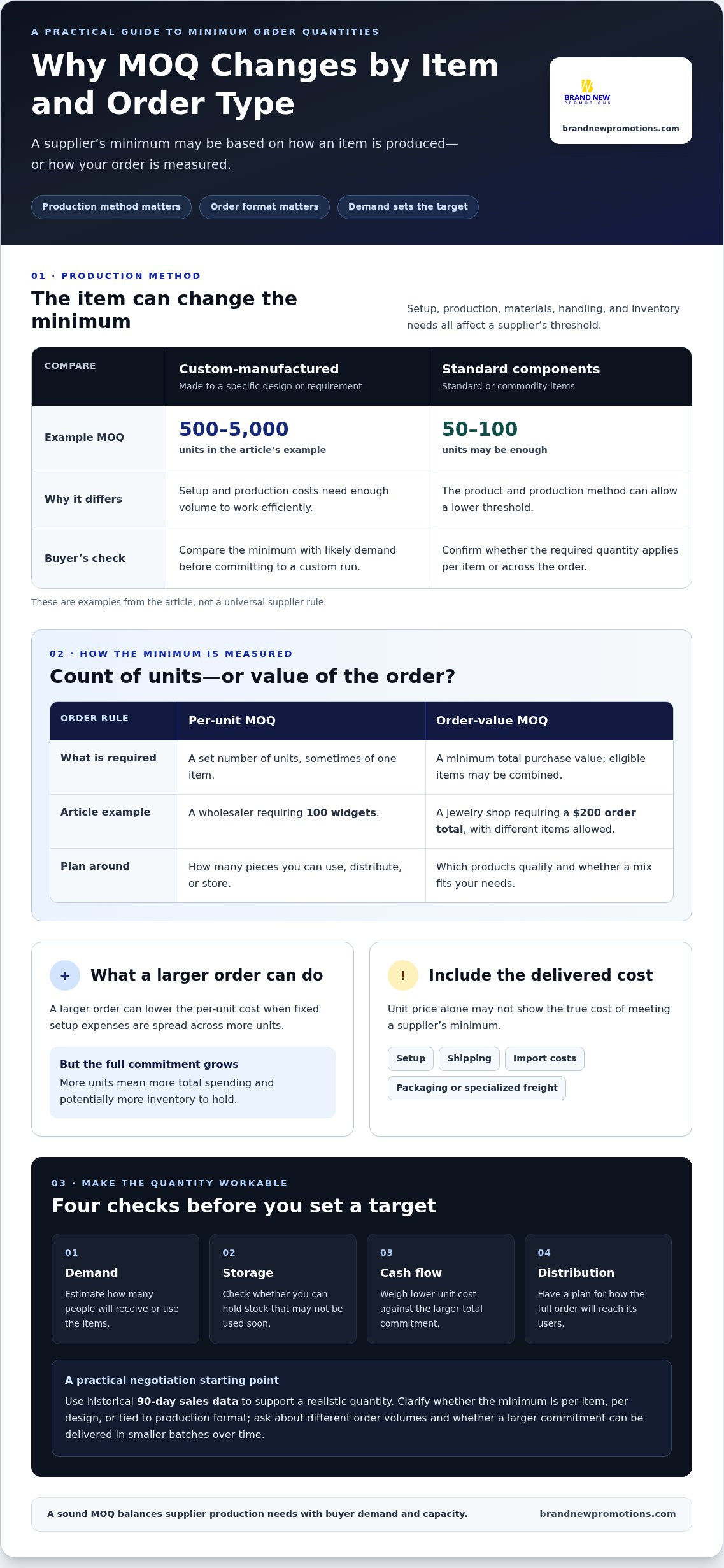
A minimum order quantity is the least number of units a buyer must order from a supplier in one purchase. For example, a wholesaler requiring 100 widgets sets its MOQ at 100 units. The threshold matters because buyers must match the required volume to demand, budget, and storage capacity.
For a business planning branded items, the MOQ helps determine whether a design or campaign makes sense at the intended scale. A small event may need fewer pieces than a company-wide launch. Compare the minimum with the number of people who will receive or use the items to reduce the risk of excess stock.
Per-Unit and Dollar Thresholds
Suppliers may express an MOQ as a set number of units or a minimum order value. A jewelry shop, for example, may require a $200 order total while allowing buyers to combine different items. In contrast, a supplier might require a specific quantity of one item. These rules affect whether buyers can mix selections or must commit to more of the same item.
Read the threshold carefully before planning volume. A dollar minimum can offer flexibility across eligible items, while a per-unit MOQ ties the order to a count. For example, a buyer choosing a mix of jewelry may reach the shop’s order value without selecting 100 of one design. Knowing which measure applies makes budgeting and allocation clearer.
The Purpose of an MOQ
Suppliers set minimums to make production and order handling workable. A custom-manufactured product may have an MOQ of 500 to 5,000 units because setup and production costs need enough volume to be efficient. For standard components or commodity items, MOQs may be as low as 50 to 100 units. The product and production method influence the threshold.
Minimums help suppliers plan materials, labor, and inventory while limiting waste. For buyers, ordering enough units can support a consistent campaign, but ordering more than you can use may tie up cash and leave stock unused. Estimate demand and consider how the items will be distributed before committing. Aim for a volume that supports your plans without creating avoidable surplus.
Setting and revisiting MOQ requirements
Set an MOQ around the order’s purpose, expected demand, and supplier’s production needs. An accessories brand, for example, may set a minimum of 6 units per SKU while also requiring a total order minimum.
Reasons Suppliers Set MOQs
Suppliers use MOQs to make production, handling, and inventory more efficient. A 6-unit-per-SKU rule helps an accessories brand define a manageable production quantity, while a separate order-total threshold can support order handling across mixed items.
A practical order has to work for both the supplier and the buyer. Treat the supplier as a production partner: clarify which minimum applies to each item and plan around likely demand.
Break-Even Points in MOQ Setting
A break-even point is the order volume where revenue covers the costs of supplying or selling an item. To assess one, compare whether selling 50 units or 500 units at the market price would produce a profit after relevant costs.
A proposed minimum is worth assessing against expected demand and production costs. If the minimum exceeds likely demand, you could be left with unused stock. If the order is too small to cover production effort, the supplier may not accept it. Both demand and cost structure matter.
Setting and Implementing MOQ Requirements
An MOQ is implemented by stating the minimum quantity buyers must purchase in a single order. For example, a supplier setting a 500-unit MOQ requires at least 500 units per order, not a smaller quantity spread across separate purchases.
Review the threshold as order patterns change. If suppliers typically receive orders around 500 units, setting a 5,000-unit minimum may be impractical. Likewise, a business selling 1,500 units monthly and ordering 10,000 would carry nearly seven months of excess stock. A realistic MOQ supports a healthier buyer-supplier relationship.
Pricing and Costs of Meeting an MOQ
A larger order can reduce the per-unit cost when fixed setup expenses are spread across more units, but it also increases the total amount you commit. Compare the unit price with the full order cost, including the budget tied up in inventory you may not use soon.
Shipping, setup, and import costs add to the true cost of meeting an MOQ. For example, bulky packaging or specialized freight can raise the delivered cost even when the unit price looks attractive. Include those expenses when assessing the break-even point, then outline your project requirements before setting a target quantity.
Supplier evaluation and MOQ negotiation
Assess an MOQ alongside the supplier’s terms and your sales plans. Historical 90-day sales data can help make your target quantity more credible.
Strategies for Lowering MOQs
First, identify what sets the minimum: total quantity, quantity per design, or production format. Then share a clear proposal that includes product specifications, intended use, and a realistic quantity. Ask which production choices affect the MOQ. A simpler design or standard material may involve different setup requirements.
Compare options on the same basis. A quote for one design may not be comparable to one covering several variations. Ask for unit prices at different order volumes, and whether a larger commitment can be fulfilled in smaller batches over time. This clarifies the tradeoffs among order size, timing, and unit cost.
Risks of Ordering More Than You Can Sell
Ordering beyond likely demand can leave a business with stock that ties up its budget and lacks a clear distribution plan. The risk is greater when merchandise is tied to a particular event, campaign, or design that may soon become outdated.
Consider a buyer who orders 400 hats and sells 250. The remaining 150 hats need a future use, such as another event or an internal program. If no suitable use exists, the surplus represents a poor match between order volume and demand. Before agreeing to a larger minimum, map who will receive the items and how they support the campaign. A realistic forecast helps retailers avoid buying merchandise simply to satisfy a supplier threshold, while keeping the order tied to its intended brand experience.
Supplier production, operational, market, and regulatory factors
An MOQ reflects more than buyer demand. Production setup, inventory planning, shipping needs, and market requirements can all affect the minimum a supplier sets.
Custom-made products generally require planning around a specific design, materials, and production setup, so their minimums may be higher than those for in-stock items. For in-stock products, order thresholds are more closely tied to available inventory and order handling.
Production scale matters. High-volume industries such as apparel or electronics can have MOQs of 10,000 or more units. A manufacturer may set a minimum to keep a production run efficient, manage inventory, and reduce waste. Buyers should weigh the requested volume against expected use, not just the appeal of a larger run.
Operational details also affect the costs associated with an order. Fresh turkeys, for example, must stay below 40 degrees during shipping, which calls for careful temperature control. That example shows how special handling can change the logistics behind a minimum. For custom merchandise, packaging, storage, and delivery arrangements likewise shape the practical order plan.
Market and regulatory factors can also influence production choices. Product specifications may affect materials, labeling, or production steps, while demand and supply can change what order volume makes sense. These factors vary by item, so consider the full order requirement in light of the product’s intended use. Inventory tracking can help teams compare planned quantities with stock already on hand.
For buyers, the clear takeaway is to connect the MOQ to both production realities and demand. A minimum that supports efficient manufacturing can still create excess inventory if it exceeds the project’s needs. Map the item’s specifications, fulfillment needs, and expected distribution before deciding on a target. Plan a custom merchandise project around the quantity and brand experience you want to deliver.
BRAND NEW Promotions | Top Promo Supplier in North Texas: promotional products
BRAND NEW Promotions | Top Promo Supplier in North Texas helps businesses and organizations connect order planning with promotional marketing goals. If you’re weighing an MOQ for an event, team, or employee program, think about how the quantity supports the experience you want people to remember.
Promotional products can build recognition when they suit the audience and campaign. For a consistent team or staff look, embroidery and embroidered polo shirts can keep your brand visible in everyday interactions. Plan how the items will be used and distributed to match the order to your needs and avoid committing to more than your campaign can use.
Bring your audience, purpose, and quantity goals together as you plan branded merchandise. Contact BRAND NEW Promotions to discuss promotional products for your business, team, or organization in North Texas.
Make Your Next Order Work Harder for Your Brand
Before placing an order, connect the quantity decision to the experience you want people to have. Consider where the items will be used, who will receive them, and how they fit your brand’s message. These choices can make the purchase a more thoughtful brand touchpoint.
Understanding minimum order quantities can also help your team make clearer decisions together. Bring purchasing, marketing, and the people who will distribute the items into the planning conversation. Their input can reveal practical needs early and keep the project focused on its purpose.
When you’re ready to shape a branded merchandise project around your goals, start a conversation with BRAND NEW Promotions. A clear purpose is a strong first step toward a memorable brand experience.
Frequently Asked Questions
What is a MOQ?
MOQ is shorthand for minimum order quantity. In a quote, product listing, or purchase agreement, look for it beside the item or SKU details. Check how colors, sizes, or designs are counted toward the minimum. This helps you compare quotes consistently and avoid assuming that separate variations count toward one combined quantity.
What is a minimum order quantity (MOQ)?
A minimum order quantity is a purchase condition that sets the smallest order a supplier will accept. For buyers, it determines whether a planned purchase can proceed as designed. For example, a school ordering apparel for several groups should map quantities by group and variation before approving the order, so the final selection meets the supplier’s terms.
How do suppliers calculate minimum order quantities?
Suppliers set minimums by assessing what makes a product run workable. They may consider cost structure, required materials, production capacity, and earnings per unit. Buyers can understand the result by comparing how changes to the design, material, or production method affect the proposed quantity. This can reveal which project choices influence the threshold.
Why do manufacturers and wholesalers set MOQs?
Manufacturers and wholesalers use minimums to manage different parts of the supply chain. A manufacturer plans around producing goods, while a wholesaler manages stock for resale. This distinction can help buyers understand whether an MOQ reflects the scale of production or how inventory is sold. The supplier’s role provides context for the order terms.
What is the difference between MOQ, minimum order value, and order multiples?
An MOQ sets a quantity floor, a minimum order value sets a spending floor, and order multiples restrict purchases to set quantity increments. For instance, if products are packed in cases of 144 units and a calculated need is 432, ordering three cases meets that quantity. Recognizing the difference helps buyers distinguish a minimum threshold from a packaging or ordering increment.
How can buyers negotiate a lower MOQ with a supplier?
To negotiate, present a specific order scenario and explain which term is the main obstacle. Ask about options that distinguish the minimum needed to place an order from the quantity required for a lower unit price. Comparing the scenarios makes the tradeoff clearer. Choose terms that suit the project, budget, and ability to manage the resulting stock.